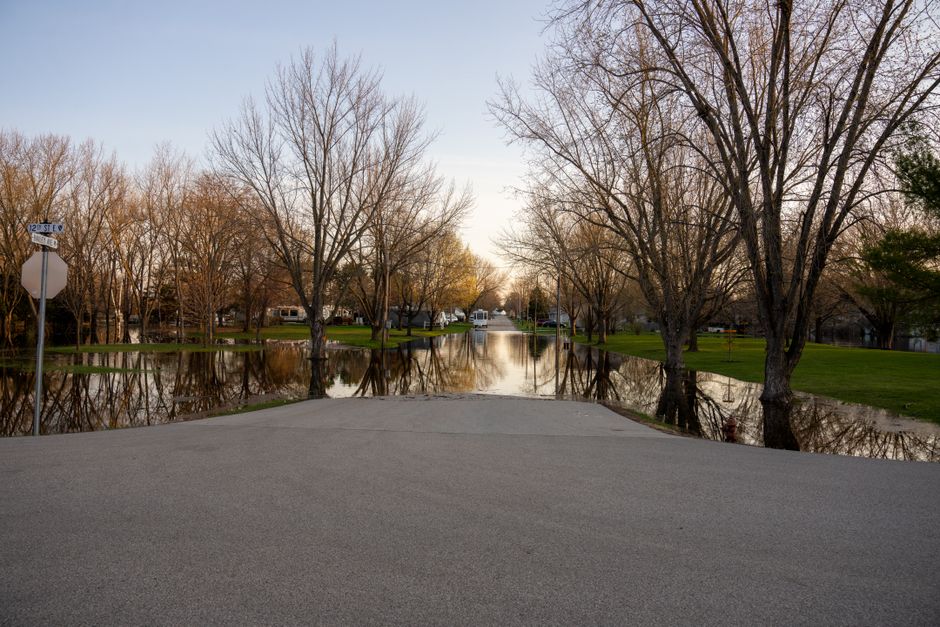
As climate change intensifies, the frequency and severity of flooding events are increasing, rendering traditional flood prediction models less reliable.Recent research emphasizes the integration of artificial intelligence (AI) into hydrological models to improve flood projections and better prepare communities for extreme weather events.Engineers and planners typically rely on hydrological models designed to predict 50- and 100-year floods.However, these models are becoming increasingly inadequate as climate change alters weather patterns, leading to more frequent and severe flooding events.
Source:
news.cornell.eduA study from Cornell University suggests that supplementing traditional physics-based models with AI-driven approaches can enhance the accuracy of flood predictions.
Source:
news.cornell.eduThe research involved creating a "virtual hydrolab" that simulated 1,000 years of synthetic data reflecting current and future climate conditions.This dataset included extreme weather events, such as floods and droughts, and was used to test various flood-prediction models.
Source:
news.cornell.eduThe study found that while all models exhibited significant uncertainties, AI-based models outperformed traditional methods in predicting flood outcomes.
Source:
news.cornell.eduSandeep Poudel, a doctoral student involved in the research, noted that the increasing unpredictability of climate conditions raises questions about the reliability of models validated on historical data."The future won't look like the past," he stated, emphasizing the need for models that can adapt to changing conditions.
Source:
news.cornell.eduIn a related effort, researchers at Northeastern University are exploring the use of AI to enhance short-term precipitation forecasting.Their project, funded by NASA, aims to improve predictions for extreme rain events that can lead to devastating floods, as seen in the 2021 Waverly, Tennessee flood, which resulted in significant loss of life and property.
Source:
news.northeastern.eduThe existing High Resolution Rapid Refresh (HRRR) model, which is physics-based, has been criticized for its inability to accurately predict such extreme events.
Source:
news.northeastern.eduPuja Das, a Ph.D.candidate at Northeastern, is working with river managers to develop better forecasting tools that combine traditional physics with AI techniques.The goal is to create hybrid models that can provide more accurate and timely flood forecasts, particularly for dam operations and flood management.
Source:
news.northeastern.eduThe urgency for improved flood prediction models is underscored by the increasing intensity and frequency of extreme weather events globally.AI's ability to process vast amounts of data and generate predictive models positions it as a crucial tool in enhancing resilience against climate-related challenges.
Source:
frontiersin.orgMoreover, a study published in Scientific Reports introduced an innovative AI-powered framework for monitoring coastal water levels, particularly in regions lacking advanced monitoring systems.This approach combines solar-powered cameras with advanced image processing models to provide real-time data on tidal cycles and storm-driven water changes.
Source:
rcei.rutgers.eduThe framework demonstrated strong accuracy compared to traditional tidal gauges, offering a promising solution for vulnerable coastal communities.
Source:
rcei.rutgers.eduThe integration of AI into flood prediction and monitoring systems not only enhances the accuracy of forecasts but also empowers communities to better prepare for and respond to flooding events.As climate change continues to pose significant risks, leveraging AI technology could be key to developing more resilient infrastructure and disaster response strategies.
Source:
frontiersin.orgIn conclusion, the application of AI in flood prediction represents a significant advancement in addressing the challenges posed by climate change.By improving the reliability of flood forecasts, these innovative approaches can help safeguard lives and infrastructure in an increasingly unpredictable climate.